roar of cards logo

GREE Shares Rise on Monster Hunter Release and Short Covers

February 19th: At the end of the day’s trading, GREE’s shares had risen 130 yen from the prior day to 1,230 ($12.30) apiece. Roar of Cards, an entry in Capcom’s extremely popular Monster Hunter series developed jointly between Capcom and Grani, was released for GREE’s social games platform today. Speculation is that high expectations for this release buoyed GREE’s share price. (Capcom’s share price also rose 3.7 percent on the day of the title’s release.)

gree share price movements 29FEB2014
capcom share price movements 29FEB2014

There is also speculation that short sellers are looking to short cover after GREE posted generally positive Q1 and Q2 combined results, contributing to the rise in the company’s share price.

GREE president with corporate logo

GREE Releases Q1 / Q2 Combined Results

February 14th: GREE released its combined Q1 and Q2 results, which reveal an overall decrease to both sales and operating profit. GREE places the blame primarily with stagnant sales through its social games. Although GREE took steps to reduce its sales and general administrative expenses (primarily through cuts to advertising costs), sales costs cut heavily into GREE’s bottom line.

Specifically, GREE reported sales of 67.9 billion yen ($679 million), operating profits of 18.9 billion yen ($189 million), and net profit of 9.8 billion yen ($98 million) for the period of JUL through DEC. In comparison to the same six-month period one year prior, these figures represent a 12.1 percent drop in sales, a 36.9 percent drop in operating profit, and a 45.8 percent drop in net profit.

Social games remain GREE’s core business, and the drop in “coins” (GREE’s in-platform currency) spent is indicative of stagnant sales through social titles. As more and more users migrate away from traditional “feature phones” to smartphones, coins spent by feature phone users have dropped accordingly. With social platforms like that provided by GREE having difficulty finding footing in the face of de facto competition from Google Play and the App Store, coins purchased and spent by smartphone users of GREE’s social platform and social titles did not compensate for the loss of paying feature phone gamers.

From JUL to DEC (2013), the number of coins spent in GREE’s social platform for games and other services was 97.8 billion, down 16 billion from the same six-month period one year prior.

GREE emphasizes that it is in the process of culling unprofitable smartphone native titles and reorganizing to improve profit from ongoing smartphone apps. GREE also points out that its efforts beyond the shores of Japan have begun to bear fruit, with Knights and Dragons turning $5 million in profit in just the space of the month of December.

Q3 outlook

For Q1 through Q3, GREE anticipates combined sales of 99 billion yen ($990 million), operating profit of 27 billion yen ($270 million), and net profit of 14.5 billion yen ($145 million).

GREE announced that it intends on focusing its releases to titles which it anticipates will be most profitable on the basis of its growing experience in the field of native apps, releasing only four titles in the remaining half of its fiscal year. GREE also anticipates that overseas business will continue to contribute toward its bottom line.

klab corporate logo

KLab Details Restructuring Efforts

In response to operating losses that were 2.1 billion yen ($21 million) deeper than KLab had anticipated, the company has announced its intentions to restructure and to absorb its subsidiaries. Today KLab released details of the restructure, which it believes will result in month-to-month sales of 1.35 billion yen ($13.5 million).

KLab will cut its number of employees to 600 in Japan and 830 globally. The staff cuts will affect all levels of employment, though the cuts will be achieved largely through hiring freezes on short-term contract employees. KLab intends on increasing its number of employees in the Philippines, although with job cuts in North America and China, taken as a whole KLab’s global employment will be reduced.

At its peak, KLab employed 765 in Japan and 246 globally, so the new numbers of domestic employees (600) and foreign employees (230) represent a 22 percent cut and a 7 percent cut, respectively.

KLab also announced that it will absorb its subsidiaries Media In Cruise, Pikkle, Dream Laboratory, and Bunkyo-Koki Co., in order to reduce costs and to streamline its operations. Further, KLab will give up one of the three floors it had been renting in its HQ in the pricey Roppongi district of Tokyo, as well as one of the floors in its Fukuoka branch office.

Finally, KLab announced that it will further cut its outsourcing costs, which are already down nearly 80 percent from their peak in the DEC 2012 to FEB 2013 quarter.

KLab is a social media and games publisher which, like many of its competitors, was caught off guard by the speed of the shift in user base to smartphones (away from traditional “feature” phones) in Japan. Although KLab has experienced success with titles such as Shin Sengokou Buster and Love Live: School Idol Festival (published by Bushi Road), the company is still in the process of shutting down non-performing browser-based titles which have experienced rapid user loss.

klab corporate office with logo

KLab Releases 16-Month Period Financials

Today, KLab announced its earnings for the 16-month period ending in December 2013. Since KLab announced earnings based on a 16-month period, a direct comparison to its anticipated sales and operating losses is difficult, but the numbers aren’t good. Sales of 20.9 billion ($209 million) yen resulted in an operating loss of 1.2 billion yen ($12 million) and a net loss of 2.5 billion yen ($25 million).

Below are some of the reasons KLab listed for its poor performance:

  • Several titles were delayed, and titles that were released performed much more poorly than had been anticipated.
  • Earnings from releases were also much lower than had been projected.
  • Large expenses were accrued in contracting costs to get delayed titles out the door.
  • Although sales from May on were close to what had been projected, royalties on franchise licenses resulted in an operating losses in subsequent months.
  • Pro Baseball: Grand Slam and Rise to the Throne did not perform as well as expected, and sales through Lord of the Dragons tapered off.
  • Poor performance in Q4 of KLab titles required us to make sudden and extensive changes to its release schedule. In the end, only one title was released in Q5, which contributed only 5.5 billion yen ($55 million).

On the plus side, KLab points out that Love Live: School Idol Festival performed well, contributing to a small operating profit in May.

For Q1 for KLab’s FY which will now end in December of 2014, the company is predicting sales of 4 billion yen (%40 million), an operating loss of 90 million yen ($900 thousand), and a net loss of 86 million yen ($860 thousand). KLab refrained from making predictions for its total fiscal year.

Falcom president Toshihiro Kondo

Nihon Falcom OCT-DEC Earnings Positive Across the Board

February 12th: Nihon Falcom released its unconsolidated figures for its first quarter (OCT-DEC 2013), and they are positive across the board. Falcom announced sales of 315 million yen ($3.15 million, up 10.5 percent from the same quarter in 2012) and operating profits of 132 million yen ($1.32 million, a 32.5 percent increase). Falcom’s net profits for the quarter were 87 million yen ($870 thousand), up 33.1 percent from the same quarter in 2012.

The Legend of Heroes: Trails of the Flash sold steadily after being released for the PlayStation 3 and PlayStation Vita in September. Ys: Memories of Celceta and The Legend of Heroes: Trails of Azure received “greatest hits” releases as PSP The Best titles, also selling well. Despite this, Falcom reports sales of 139 million yen ($1.39 million), which although impressive are down 10.3 percent from the same quarter one year prior.

Through licensing, Falcom earned 176 million yen ($1.76 million), an impressive 35.4 percent increase from the same quarter one year prior. Most of these earnings came through the English-language release of Falcom’s titles to Steam and the positive Western reception to the PlayStation Vita release of Ys: Memories of Celceta.

falcom titles on steam

On the basis of these positive figures and other data, Falcom is predicting sales of 1.9 billion yen ($19 million), operating profit of 750 million yen ($7.5 million), and net profit of 460 million yen ($4.6 million) for its fiscal year ending in September of this year. These figures represent a 3.2 percent increase, 5.5 percent increase, and 5.5 percent increase to sales, operating profit, and net profit (respectively) from Falcom’s fiscal year which ended in September of 2013.

klab corporate logo

KLab Anticipates Loss of $25M, Will Absorb Subsidiaries

February 12th: KLab has announced that it anticipates a loss of 2.4 billion yen ($25 million) for its fiscal year ending in December of 2013. KLab had initially predicted a loss of 300 million yen ($3 million), but due to underwhelming sales of its titles released in the 4th quarter (OCT-DEC), release schedule changes, and restructuring expenses, KLab’s Q4 losses blew up to 1.35 billion yen ($13.5 million).

KLab has readjusted its sales estimate for the financial year to 20.99 billion yen ($209.9 million), 1.97 billion yen ($19.7 million) less than its previous estimate. Similarly, KLab has readjusted its estimated operating loss to 1.22 billion yen ($12.2 million), which is 124 million yen ($1.24 million) worse than its previous estimate.

KLab has also announced that as of April 1st, it will absorb its fully-owned subsidiaries Media In Cruise, Pikkle, Dream Laboratory, and Bunkyo-Koki Co., in an effort to reduce costs and to streamline its operations.

DeNA corporate logo

DeNA Shares Rise on Attack on Titan Release

February 10th: although share prices for the games sector remained flat, DeNA finally got a bit of good news as its share price rose 16.27 percent to finish the day at 2,130 yen (USD 21.30). DeNA’s share price was bolstered by news that its recently released smartphone app based on the popular Attack on Titan franchise had made it to 30th on the App Store sales rankings.

DeNA’s smartphone titles Pazu Oku and Sangokushi Royale also breached the top 50, further contributing to share price gains.

It’s also likely that investors are taking advantage of DeNA’s low share price to conduct short covering, and that this also contributed to the rise in DeNA’s share price.

DeNA's 10FEB2014 share price movement

Nippon Ichi Logo

Nippon Ichi Software Adjusts Projections Upward For FY2013 Thanks To Strong Sales

Nippon Ichi Software has revised their consolidated performance forecast upward for the current fiscal year (ending March, 2014), and has revised their projected operating profits upward from 317 million yen (3.17M USD) to 441 million yen (4.41M USD). This comes as a result of their packaged retail software exceeding performance expectations in Japan.

Nippon Ichi also announced further revisions to their projections for the fiscal year. They are now projecting sales of 3.413 billion yen (34.13M USD; up from 31.9M USD), pretax profits of 465 million yen (4.65M UDS; up from 3.32M USD), and net profits for the year of 363 million yen (3.63M USD; up from 2.74M USD).

These revised predictions represent a 7% increase in projected sales, a 39% increase in projected operating profits, a 40.1% increase in projected pretax profits, and a 32.3% increase in projected net profits for the year.

Chart1

The company explained that these revisions come as a result of an increase in the number of packaged retail copies of games they are expecting to sell both in Japan and overseas, and as a result of the exchange rate being better than initially projected.

Gaming news website Social Gaming Info reports that both the retail and downloadable versions of Nippon Ichi Software’s Criminal Girls: Invitation, as well as The Witch and The Hundred Knight have sold well in Japan, and that Disgaea D2: A Brighter Darkness has sold especially well overseas.

Nippon Ichi Software also presented the results of its financial performance through the third quarter of its current fiscal year, which marked a strong return to profitability for the company. Sales reached 2.777 billion yen (27.77M USD; up 99.1% from the same period last year), operating profits reached 478 million yen (4.78M USD; up from a loss of 0.78M USD during the same period last year), pretax profits reached 505 million yen (5.05M USD; up from a loss of 0.66M USD during the same period last year), and cumulative net profits reached 398 million yen (3.98M USD; up from a loss of 0.24M USD during the same period last year).

Chart2

square enix logo

Square Enix Earnings for OCT through DEC

February 5th: Square Enix released an earnings briefing with figures for its OCT through DEC quarter (Q3 for Square Enix). Square Enix’s consolidated cumulative third quarter sales totaled 102.47 billion yen (approx. USD 1.02B), which was a a 0.3 percent decrease from the same quarter one year prior. Square Enix reported operating profits of 7.8 billion yen (USD 78M), a market improvement from its operating loss of 4.8 billion yen in Q3 one year ago.

Breaking down these figures, Square Enix reports 56.5 billion yen (USD 565M) came from its digital entertainment operations, a 2.2 percent improvement from the previous Q3. Operating profits were 6.7 billion yen, up from a 392 million yen operating loss.

Revenues through digital downloads to home consoles have gained steadily in North America, and Final Fantasy XIV: A Realm Reborn is selling well. Both have contributed to Square Enix’s financial improvement.

The browser-based title Sengoku IXA (developed in collaboration with ONE-UP , the developers of Browser Sengokushi) has steadily gained users. Square Enix’s Million Arthur series is also performing well, with a PlayStation Vita port in April 2013 and expansion of services for smartphone versions of Kaku-San-Sei Million Arthur to Korea, Taiwan, and mainland China.

Square Enix reports its “amusement” operations (under which Square Enix categorizes its arcade offerings) produced sales of 36.1 billion yen (USD 361M), up 7 percent from last year, and operating profits of 4.3 billion yen (USD 43M), up from an operating loss of 316 million yen (USD 3.16M). Square attributes this turnaround to titles like its “multi-player online battle arena” game Lord of Vermillion III and the arcade version of its title Groove Coaster.

In addition to licensing and the sale of merchandise such as character goods and soundtracks for its own properties, Square Enix bolstered its lineup with popular properties licensed from other companies, and expanded the extent of such sales in countries outside of Japan. As a result, Square Enix reports sales of 2.6 billion yen (USD 26M) and operating profits of 642 million yen (USD 6.42M) from licensing and merchandise. This works out to a 10.7 increase in sales, and a remarkable 70.4 percent increase in operating profits from the previous Q3.

Earnings through Square Enix’s publishing efforts were not as positive. Sales of Square Enix’s popular manga series declined, with no new franchise stepping in to take up the slack. Although Square Enix reports sales of 7.5 billion yen (USD 75M) and operating profits of 1.6 billion yen (USD 16M), in comparison to last year, these are decreases of 13.9 percent and 18.5 percent, respectively.

drecom corporate logo

Drecom Earnings for OCT through DEC

January 30th: Drecom held a conference to report its Q3 earnings (OCT through DEC) and to address its financial situation. Drecom reported Q3 sales of one billion 713 million yen (USD 17.13M), up from one billion 681 million yen the previous quarter (JUL through SEP). This is the first quarter-on-quarter rise in sales for Drecom in four financial quarters.

Although Drecom reported an operating loss of 91 million yen (USD 910K), this was a marked improvement from its previous quarter operating loss of 232 million yen (USD 2.32M).

drecom oct to dec sales and operating profits

Although Drecom continues to lose users of its browser-based titles, the pace of the drop relaxed in Q3, and growth in Drecom’s smartphone advertising programs helped to compensate. Cost-cutting efforts also contributed toward Drecom’s turnaround.

Drecom’s president Yuuki Naitou also announced Drecom’s involvement in the development of two smartphone titles: JoJo’s Bizarre Adventure: Stardust Shooters and One Piece: Treasure Cruise. Both titles are based on extremely popular franchises, and are expected to draw a large audience.

Drecom released Furubokko Heroes (developed in collaboration with CyberConnect2) on January 27th for iOS and February 3rd for Android. Drecom intends for these three titles to reach the top 10 in sales on the Japan App Store and Google Play Japan.

QoQ comparison of sales and profits

Although Drecom’s Q3 sales and profits are down from those of the same quarter one year prior, they represent Drecom’s first QonQ improvement in a year and exceeded Drecom’s own predictions. Drecom had predicted sales of 1.6 billion yen (USD 16M) and an operating loss of 300 million yen (USD 3M).

drecom QoQ operating profits and expenses

Drecom reports it had been more successful than it had predicted it would be in bringing expenses under control, and that its data indicates its losses on browser-based titles have bottomed out and stabilized. Drecom reports it has taken efforts to cater to its remaining core users of its browser-based titles, and that these efforts appear to have been effective.

Drecom’s advertising solutions and technologies aimed at smartphone users have rapidly turned a profit, bringing the advertising solutions segment of Drecom’s business up 90 percent. Q3 sales related to advertising solutions totaled 191 million yen (USD 1.91M), up from 101 million yen (USD 1.01) one quarter prior.

Drecom reports that its “social learning” technologies, utilized in its advertising solutions, had been still been under development in previous quarters and have now begun to mature and contribute toward profit.

Furubokko Heroes

To build anticipation for the release of Furubokko Heroes, Drecom had given pre-registrants the chance to try their luck on a special gacha (random prize dispenser) to receive powerful items to use from the title’s release. The unusual tactic was successful, bringing in 350K pre-registrants in the space of a month, which contributed toward positive buzz for Furubokko Heroes before its release.

Naitou went into the details of the pre-registration campaign. Many titles give users a gacha chance when they download the title. The result has been the phenomenon of the “download marathon”, wherein a user will download a title, cash in his free try at the gacha, and then delete the game from his smartphone and repeat the process until he gets a rare prize.

Rather than try to curb this behavior, Drecom tried a different tactic. Pre-registrants were given five opportunities to win prizes from the gacha. Users who shared the results of their gacha attempts via Twitter automatically received more chances, effectively allowing them to repeat the process as long as they wished. Naitou explains, “This way, the more users tried the gacha, the more viral it went.”

Typically, pre-registration campaigns result in an early surge of registrants followed by a quick and large drop-off. For Furubokko Heroes, the opposite was the case: the more people who registered and sent out tweets, the more new registrants joined. Without spending a single yen on post-release advertising, Furubokko Heroes has already surpassed over 100K downloads. (Furubokko Heroes was released on iOS on the January 27th, and on Android on February 3rd.)

All is not positive, however. After approaching 30th in sales on the 28th, Furubokko Heroes plateaued, dropping below 40th place as of the 30th. Naitou explains: “Their are two approaches to including gacha systems in social games. One approach is to allow users to try their hand at the gacha to get powerful cards for their decks right from the outset. Another approach is to limit the costs involved in putting together a deck, including new cards won through the gacha in users’ decks when they level up. [...] We went with the latter, so we expect that sales will slowly increase as more users level up. [...] We’ll also run promotions to keep players invested.”

drecom furubokko heroes app store sales ranking

Jojo and One Piece

Drecom has teamed up with Bandai Namco to bring titles based on the Jojo’s Bizarre Adventure and One Piece franchises to smartphones. Naitou was limited in what he could say about both titles, revealing only that Drecom would calculate profits from both titles as net profits (rather than gross), after commissions and fees and revenues shared with Bandai Namco had been factored out.

Naitou stressed that Bandai Namco entrusting Drecom with this franchises was indicative of the strong bond between the two companies.

Smartphone advertising solutions and social learning tech

Naitou goes on to address Drecom’s smartphone advertising solutions. “Apple frequently changes the programming logic by which it calculates download aggregates, and it can be difficult for content providers to keep up. Because rankings are so important to the success of smartphone titles, Drecom has gone to great lengths to address this concern for its own products. Because other companies are wrestling with the same concern, we thought we’d put together advertising solutions based on our own technologies. The response has been quite positive.”

drecom ad services

When asked if Drecom has plans to incorporate popular franchises with its social learning technologies, Naitou responds, “We’re getting a lot of requests to work with other companies. There are a lot of companies who are glad to lend out their licenses so long as it’s not for a game.” However, Naitou explains that the technology is still under development, so Drecom will maintain a neutral stance for the immediate future.

Drecom going forward

Naitou also took some time to discuss Drecom’s plans moving forward. “We aren’t factoring Jojo and One Piece into our plans for the current quarter much. We’re largely basing our plans on the titles that have already been released.” Naitou points out that Furubokko Heroes has only just been released, and that the release dates for Jojo and One Piece may change. (Both titles are currently scheduled for a spring release.)

As for advertising expenses: “It depends on how things go. If our applications produce steady growth, we may consider purchasing advertising ahead of time.” Regarding Furubokko Heroes and Drecom’s upcoming releases: “We’re not looking just to reap short-term gains. Our intent is to see all of these titles reach the top 10 [on the App Store and Google Play]. Any advertising expenses will be with the intent of reaping large, long-term gains.”

GungHo

GungHo FY2013 Earnings by Platform and Market Sector

February 3rd: GungHo Online Entertainment released the figures for its financial year ending in December 2013. Thanks largely to its flagship series Puzzle & Dragons, GungHo achieved remarkable increases in overall sales and operating profits.

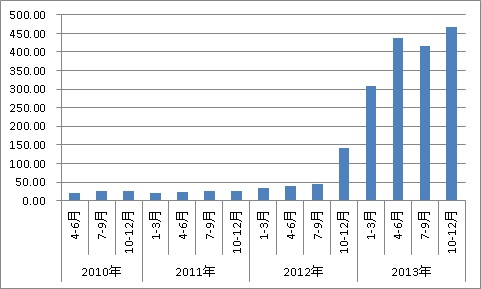
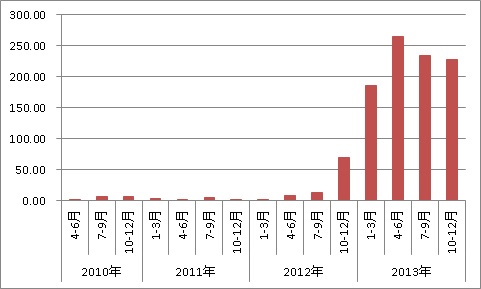
At 163 billion yen (USD 1.63B), GungHo’s sales were up 531.5 percent in comparison to FY2012, and at 91.2 billion yen (USD 912M), its operating profits increased 863.1 percent. Gungho’s net profits were 54.7 billion yen (USD 547M), an increase of 567.1 percent.

Earnings by OS

GungHo’s sales through the App store totaled 69.1 billion yen (USD 691M) for the fiscal year ending in December 2013. Sales through Google Play for the same period totaled 81.5 billion yen (USD 820M). Calculated as percentages, 42 percent of GungHo’s profits for the financial year were earned via the App Store, with 50 percent earned through Google Play.

Looking back one year, GungHo took in 9.8 billion yen (USD 98M) and 5.2 billion yen (USD 52M) through the App Store and Google Play, respectively. Making a year-to-year comparison, App Store earnings for the financial year ending in December 2013 were 7 times that of the previous financial year, while Google Play earnings were 15.6 times those of the previous year. In addition to demonstrating GungHo’s remarkable growth through 2013, these figures are also indicative of the turnaround the Android OS is enjoying Japan as it steadily moves toward overtaking Apple’s iOS in terms of market share.

Earnings by market sector

GungHo’s earnings through online software and applications for PCs totaled 6 billion yen (USD 60M), a 25.3 percent decrease from FY2012, which resulted in an operating loss of 800M yen (USD 8M). One reason for the decline in sales is the user base shift away from PCs to smartphones for social networking and applications.

Ironically, another reason is a streamlined user experience. For many of its applications, GungHo did away with the need to log in to the application to participate in community message boards and activities. Users only interested in these community elements no longer logged in to the application, resulting in decreased ad revenue and other sales.

In the mobile sector, GungHo’s sales totaled 157.2 billion yen (USD 1.6B), a 772.5 percent increase in comparison to FY2012, with operating profits of 93.4 billion yen (USD 934M) — a remarkable 972.5 percent increase.

Among GungHo’s mobile applications, Princess Punt and Divine Gate established themselves as tent pole titles. Princess Punt is currently at 24th place on the Japan App Store rankings in the games category, and 13th in the Google Play Japan rankings.

However, the majority of GungHo’s earnings came from the Puzzle & Dragons franchise. Sales related to Puzzle and Dragons (including sales from its iOS and Android versions and the Nintendo 3DS version Puzzle & Dragons Z, released on December 12th) totaled 148.5 billion yen (USD 1.5B), an increase of 917.8 percent from the previous fiscal year. This accounts for 91.1 percent of GungHo’s earnings in FY2013.

Quarter-on-quarter comparison

Quarter on quarter, GungHo saw an increase in sales but a small decrease in operating profits. OCT-DEC sales totaled 46.7 billion yen (USD 467M), a 12.4 percent increase from the JUL-SEP quarter, but at 22.7 billion yen operating profits were down 2.8 percent. Net profits for the OCT-DEC quarter were 12.1 billion yen (USD 121M), a 15.8 percent QoQ decrease.

GungHo sales by year and quarter

gungho financials SEP through DEC 2013

GungHo operating profit by year and quarter

gungho financials SEP through DEC 2013

GungHo also reported its estimated earnings for the month of January: 16.5 billion yen (USD 165M), a 187.4 percent increase from January 2013.

cyberagent logo

CyberAgent Financials for OCT – DEC

January 30th: CyberAgent released its first quarter consolidated statement to the public. CyberAgent’s first quarter was from October to December of last year, during which the company arrived at the following results:

  • Sales: 43.3 billion yen, an increase of 7.1 percent in comparison to Q1 of the previous year.
  • Operating profit: 4.2 billion yen, an increase of 176.2 percent in comparison to Q1 of the previous year.
  • Operating income: 4.3 billion yen, a 166.5 percent increase
  • Net profit for Q1: 2 billion yen, a 36.4 percent decrease

CyberAgent also announced that the prior investment period for the smartphone version of its SNS / games platform Ameba was at a close, now moving toward making profits.

Business operations related to Ameba yielded sales of 7.9 billion yen, a 30 percent increase from the same period of the previous year, and operating profits of 34M yen, a market improvement from the 3 billion yen loss in the same quarter of the previous year.

The turnaround is attributed to CyberAgent’s release of a smartphone version of the SNS / games platform, and improvements to the quality and management of the existing versions, which lead to improved revenue from Ameba titles and advertising. With the prior investment period for the smartphone version of Ameba also out of the way, the platform was able to turn a modest but important profit.

CyberAgent’s social applications and native applications were also profitable, yielding sales of 14.7 billion yen (a 6.6 percent decrease from the same period in the previous year) and operating profits of 2.1 billion yen (a 120.5 percent increase).

cyberagent SAP and native apps translated

From traditional Internet advertising, CyberAgent gained sales of 24.2 billion yen (an increase of 25.1 percent in comparison to the same period of the previous year) and operating profits of 2 billion yen (a 1.3 percent decrease). CyberAgent has been successful in expanding its smartphone advertising operations, but due to investments in ad technologies, operating profits remained at previous amounts.

For the business period ending in September of this year, CyberAgent is predicting sales of 180 billion yen (a 10.8 percent increase in comparison to the year prior), operating profits of 20 billion (a 93.8 percent increase), and operating income of 20 billion yen (an increase of 89.2 percent). CyberAgent also predicts net profits of 10 billion yen (a 4.8 percent increase) for the period.

square enix logo

Social Game Info Market Movements: Square Enix, colopl, GungHo Continue to Shine

Tokyo Stock Exchange, January 29th: games industry share prices saw general advances across the board. In particular, gains stood out for GungHo Online Entertainment (which has recently had its earnings reported upon), Square Enix Holdings (benefiting from the overwhelmingly positive response to its smartphone title Dragon Quest Monsters Super Light), CyberAgent, and colopl (despite colopl refraining from making an earnings announcement).

GungHo’s share price rose 53 yen to land at 673 yen, spurred on by an estimation in the January 29th edition of the Nikkei that GungHo’s operation earnings for the period ending in December were in the vicinity of 90 billion yen, a 10-fold increase from the previous period. In its quarterly estimate, GungHo had predicted operation earnings of 88 billion yen, so the Nikkei’s report was not out of line with expectations, but the positive news still had a beneficial effect on GungHo’s share price.

gungho stock price 29JAN2014

colopl’s share price also rose, up 240 yen from the previous day to finish the day’s trading at 3,920 yen. colopl refrained from making an earnings announcement after the close of the trading session, leading to speculation that the bump in share price is the result of high investor anticipation.

Previously, colopl revised its earnings forecast for the period which will end in September of this year, raising its operations earnings estimate from 12 billion yen to 18 billion. Touyou Keizai’s Japan Company Handbook had also pinned its estimate for the period at 12 billion yen, so there is keen interest in how Touyou Keizai and other institutions react to colopl’s forthcoming announcements.

colopl stock price 29JAN2014

There was also more good news for Square Enix Holdings, its share price rising 161 yen in the course of the day’s trading to end at 2,830 yen. Square Enix Holdings’ share price had risen dramatically in response to its title Dragon Quest Monsters Super Light rocketing to second place of the Japan App Store sales rankings in the games category, where it remains as of today behind only GungHo’s Puzzle & Dragons. Today’s increases are attributed to Super Light making it to 11th place in the Google play Japan rankings (games category), where it threatens to crack the top ten.

square enix share price 29JAN2014

CyberAgent, part owner of Super Light developer CyGames, also saw an increase in share price to the tune of 260 yen, ending the day at a total of 4,985 yen.

cyberagent share price 29JAN2014

Noteworthy movements in the games industry and mobile market are as listed below:

Company name Current share price Single-day change Single day change (%)
GungHo Online Entertainment 673 53 8.55%
colopl 3,920 240 6.52%
Square Enix HD 2,830 161 6.03%
Koei Tecmo HD 1,297 68 5.53%
CyberAgent 4,985 260 5.50%
Bandai Namco HD 2,462 112 4.77%
Sega Sammy HD 2,535 91 3.72%
Aeria, Inc. 1,890 65 3.56%
Nippon Ichi Software 846 29 3.55%
GMO Internet 1,334 43 3.33%
Marvelous AQL 710 21 3.05%
Konami 2,472 69 2.87%
NEXON 902 24 2.73%
AXEL MARK 878 23 2.69%
enish 2,769 70 2.59%
Mixi 6,000 150 2.56%
Crooz 4,820 120 2.55%
Alt Plus, Inc. 2,403 59 2.52%
Voltage 1,661 31 1.90%

dragon quest monsters super light logo

DQM Super Light Tops 1M DLs in Four Days, Spurring on Positive Investor Response

Square Enix Holdings’ share price reached its maximum allowed single-day gain of 500 yen per share to finish January 27th trading at a share price of 2,581 yen. The continued growth in share price is in response to news that the company’s smartphone title Dragon Quest Monsters Super Light exceeded a million downloads in the space of only four days.

square enix share price 27JAN2014

As of today, Super Light is behind only Puzzle & Dragons in the Japanese App Store sales ranking. The positive response has brought Square Enix Holdings’ share price to its highest figure in over four years.

dragon quest monsters promo screens

Square Enix Shares Soar as DQM Super Light Leaps to 5th in Sales

January 24th: Square Enix Holdings’ share price reached its maximum allowable single-day gain of 400 yen to finish the day’s trading at 2,081 yen, an increase of 23.8 percent. The gains are attributed to Square Enix’s January 23rd release of Dragon Quest Monsters Super Light, which rocketed to 5th place on the App Store sales rankings games category within a single day.

square enix sales screen shot

Dragon Quest Monsters, a spin-off of the ubiquitous Dragon Quest series, has become a popular series in its own right, spawning countless titles across numerous consoles and mobile devices. Super Light is the first Dragon Quest Monsters title developed from the ground up for smartphones and tablets. It is also the first free-to-play title in the series, monetized through in-game purchases.

Super Light has been a tremendous hit with smartphone and tablet owners, going from 12th place in the App Store rankings (in the games category) at 10:00 AM (Tokyo) to 9th place at 2:00 PM, finally arriving at 5th place as of 5:00 in the evening. News of Super Light‘s success drove up Square Enix Holdings’ stock price through the course of the 24th, bringing the company’s share price to its highest level in over four years.

square enix sales screen shot

Super Light was developed by CyGames, a subsidiary of CyberAgent. Like Square Enix Holdings, CyberAgent’s share price rose steadily through the day in response to Super Light‘s success. During trading on the 24th, CyberAgent’s share price briefly reached its maximum allowable single-day gain of 5,350 yen before dipping slightly to end the day at 5,170, an aggregate increase of 11 percent. This is CyberAgent’s highest end-of-day share price in ten years.

square enix sales screen shot 02

However, it’s worth noting the trajectory taken by another Square Enix title: Dragon Quest VIII. Like Super Light, Dragon Quest VIII brushed aside popular and established mobile titles as it rocketed to the top of the sales rankings. Despite its 2,800 yen price, Dragon Quest VIII jumped past Quiz RPG: The Mystic World of Wiz and LINE Corp.’s Pokopan to seize the second spot in terms of sales, unable to dethrone only GungHo’s indomitable Puzzle and Dragons. Dragon Quest VIII‘s sales went on the decline steadily before slipping outside of the top 50 by mid-January.

square enix sales screen shot

Still, for Square Enix, having struggled to regain a steady foothold, this show of investor faith in its decision to release versions of its big-name titles for mobile devices must come as a powerful reassurance.

At the end of trading on the 24th, notable shifts in share price of 25 top games publishers were as follows:

Company Share price Change in yen from the previous day’s share price Change as percentage
Square Enix HD 2,081 400 23.80%
CyberAgent 5,170 520 11.18%
A Team 9,040 540 6.35%
GREE 1,180 50 4.42%
colopl 4,110 110 2.75%
Capcom 1,930 46 2.44%
KLab 917 19 2.12%
enish 2,850 52 1.86%
Marvelous AQL 753 6 0.80%
Konami 2,367 6 0.25%
Sega Sammy HD 2,539 -13 -0.51%
MobCast 1,333 -7 -0.52%
Nexon 916 -6 -0.65%
Nihon Falcom 1,042 -8 -0.76%
DeNA 2,205 -28 -1.25%
AXEL MARK 903 -12 -1.31%
Koei Tecmo HD 1,184 -18 -1.50%
Bandai Namco HD 2,195 -37 -1.66%
Nippon Ichi Software 854 -16 -1.84%
GungHo 683 -13 -1.87%
Nintendo 13,560 -290 -2.09%
Mixi 6,880 -160 -2.27%
Voltage 1,852 -43 -2.27%
Cave 3,925 -95 -2.36%
Eighting 1,873 -55 -2.85%